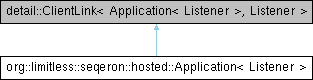
The client stub of a hosted Application (doc/seqeron-protocol-spec.md §17): the surface of app::Application, with the façade itself running in a host process that this talks to over schema 218. More...
#include <org/limitless/seqeron/hosted/Application.hpp>
Classes | |
| struct | Config |
Public Member Functions | |
| Application (Config config, Listener &listener) | |
| bool | canPublish () const noexcept |
| What the last Gate said (H-16); lags the host by a hop. | |
| bool | isLeading () const noexcept |
| protocol::Publish | publish (const std::uint16_t payloadId, const std::uint8_t *payload, const std::uint16_t payloadLength) |
| Offers one payload of this application's own to its own group (H-4). | |
| protocol::Publish | publish (const std::uint16_t groupMask, const std::uint16_t payloadId, const std::uint8_t *payload, const std::uint16_t payloadLength) |
| The same to the groups groupMask names as well as its own. | |
| protocol::Publish | reply (const app::ReplyAddress &request, const std::uint16_t payloadId, const std::uint8_t *payload, const std::uint16_t payloadLength) |
| The same on behalf of the producer that asked for it (H-11): the reply carries the request's sourceId, connectionId and groupMask. | |
Detailed Description
class org::limitless::seqeron::hosted::Application< Listener >
The client stub of a hosted Application (doc/seqeron-protocol-spec.md §17): the surface of app::Application, with the façade itself running in a host process that this talks to over schema 218.
Its listener is the direct Application's, and a Payload reaches it as it would there.
What differs: a Published command can be lost at a gate edge (H-3, H-4), the queries mirror the host's last Gate (H-16), and a snapshot cut is answered from the listener the Config names. The Gateway's is hosted::Gateway.
Single-threaded: every method belongs to the caller's one duty-cycle thread.
Constructor & Destructor Documentation
◆ Application()
|
inline |
Member Function Documentation
◆ canPublish()
|
inlinenoexcept |
What the last Gate said (H-16); lags the host by a hop.
◆ isLeading()
|
inlinenoexcept |
◆ publish() [1/2]
|
inline |
The same to the groups groupMask names as well as its own.
- Parameters
-
groupMask bits from the GroupDirectory; one the table lacks is Refused payloadId the payload's protocol payload the payload's first byte, its own messageHeader included if it has one payloadLength the payload's length
◆ publish() [2/2]
|
inline |
Offers one payload of this application's own to its own group (H-4).
The result is an offer's, not the cluster's: Published means the host may place it. A gate edge in flight drops it, and the stub resends it when the gate reopens (H-17).
- Returns
- Published; Declined while the gate is shut, the window is full or stream 304 is back-pressured, to retry; Refused, permanently, for the local checks of a direct Application
◆ reply()
|
inline |
The same on behalf of the producer that asked for it (H-11): the reply carries the request's sourceId, connectionId and groupMask.
- Parameters
-
request the request's ReplyAddress, kept from its Payload payloadId the reply's protocol payload the reply's first byte, its own messageHeader included if it has one payloadLength the reply's length
The documentation for this class was generated from the following file:
- org/limitless/seqeron/hosted/Application.hpp